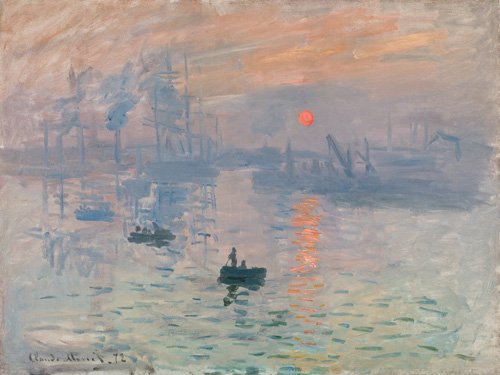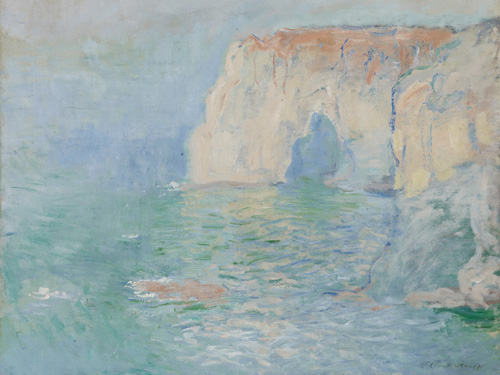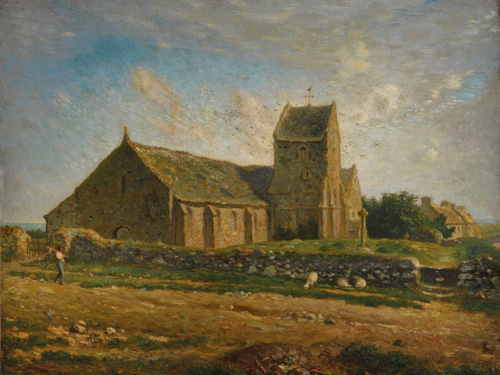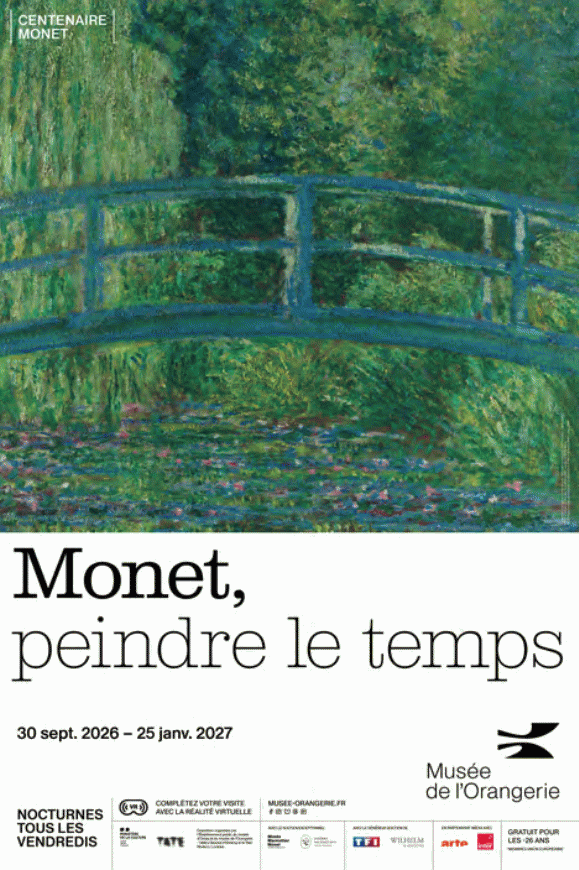
2026 will mark the centenary of the painter Claude Monet’s passing (1840-1926). To commemorate this anniversary, the musée de l’Orangerie is organizing an exhibition focusing on the relationship between Monet’s work and time, from September 29th 2026, to January 25th 2027: Monet, painting time.
Already considered the Impressionist artist par excellence in the 1870s – even though he only took part in five of the group’s exhibitions – his works soon became synonymous with the ‘”new painting’’, as they summed up the movement’s characteristics so well, being most often painted outdoors, with rapid touches and bright harmonies recording a fleeting impression. Monet would later develop Impressionism in the most original and remarkable manner through the 1890s, with his series, for example focusing on cathedrals, haystacks or poplars, an approach that came close to a way of dissecting time. Later, Monet would leave us his final testimony, the Nymphéas (Water Lilies), which resolved the philosophical puzzle of his series, melding into an entrancing continuum.
A selection of almost 40 of Monet’s paintings, mainly from the collections of Paris’s musée d’Orsay and musée Marmottan Monet, but also with loans from public and private French and international collections, will underline these different periods in Monet’s career, focusing most especially on the Nymphéas (Water Lilies) cycle. Viewing Monet’s work from an original angle, and presenting an overview taking into account varied fields of research, this exhibition aims to get visitors to reexamine an artwork whose influence, a hundred years later, remains more fundamental than ever.
It makes perfect sense that this exhibition, paying homage in particular to Monet in later life, should take place in the Musée de l’Orangerie, already home to the Grandes décorations des Nymphéas as conceived by the great artist. This unique ensemble, the ‘‘Sistine Chapel of Impressionism’’, as artist André Masson described it in 1952, bears such testimony to Monet’s late work, designed to create a fully rounded artistic environment, and presenting the crowning achievement of Monet’s whole cycle of Nymphéas (Water Lilies).
Monet developed a style of painting that responded to the challenges and upheavals of his era, focusing on the concept of time from a perspective that was both lived and felt, but also tangible through the concrete signs of transformation in urban spaces and landscapes. The 19th century saw the spread of clocks in public spaces and the synchronization of measured time, as well as the revolution in transport and the development of railways. Monet’s Impressionist moment thus appears, echoing this revolution in the understanding of time in the 19th century, as that of a painting that seeks to become increasingly instantaneous.
After the years when the Impressionist exhibitions took place, the artist showed a trend towards exploring the effects produced at different times of day on the same subject. It was in Normandy that he finally developed his famous series on haystacks, (1888-1891), Poplars on the Banks of the Epte (1891-1892), Mornings on the Seine (1896-1897), and Rouen Cathedral (1892-1898). Through these series, the painter pushed the logic of representing the moment to the point of fragmenting time in order to better capture its essence. In 1895, the Rouen Cathedrals exhibited at Durand-Ruel’s gallery were, for Clemenceau, equivalent to “a revolution without gunfire” (Clemenceau, “Révolution de Cathédrales” in 1895 in La Justice). With these pictorial explorations, Monet seems to have shared his era’s fascination with the meticulous, almost scientific observation of the world around him.
In the 1890s, Monet began the final cycle that would occupy him until his death in 1926: the Nymphéas (Water Lilies). This cycle comprises more than 250 paintings on the same subject and is crowned by the creation of two rooms designed specifically to house his large panels, which were donated to France after the 1918 armistice. The painter’s final work was inaugurated a year after his death in 1927. Everything comes together to envelop the viewer in the work in a way that is close to duration in the Bergsonian sense of the term.
To prolong the immersion, the Monet, painting time exhibition is paired with a virtual reality experience. Entitled Monet au fil de l’eau (Monet along the water), it offers a unique journey into the heart of the Impressionist master’s work.

Practical informations
30th sept. 2026 - 25th jan. 2027
Musée de l'Orangerie
Place de la Concorde75001 Paris Tel. : +33 (0)1 44 77 80 07

Practical informations
30th sept. 2026 - 25th jan. 2027
Musée de l'Orangerie
Place de la Concorde75001 Paris Tel. : +33 (0)1 44 77 80 07