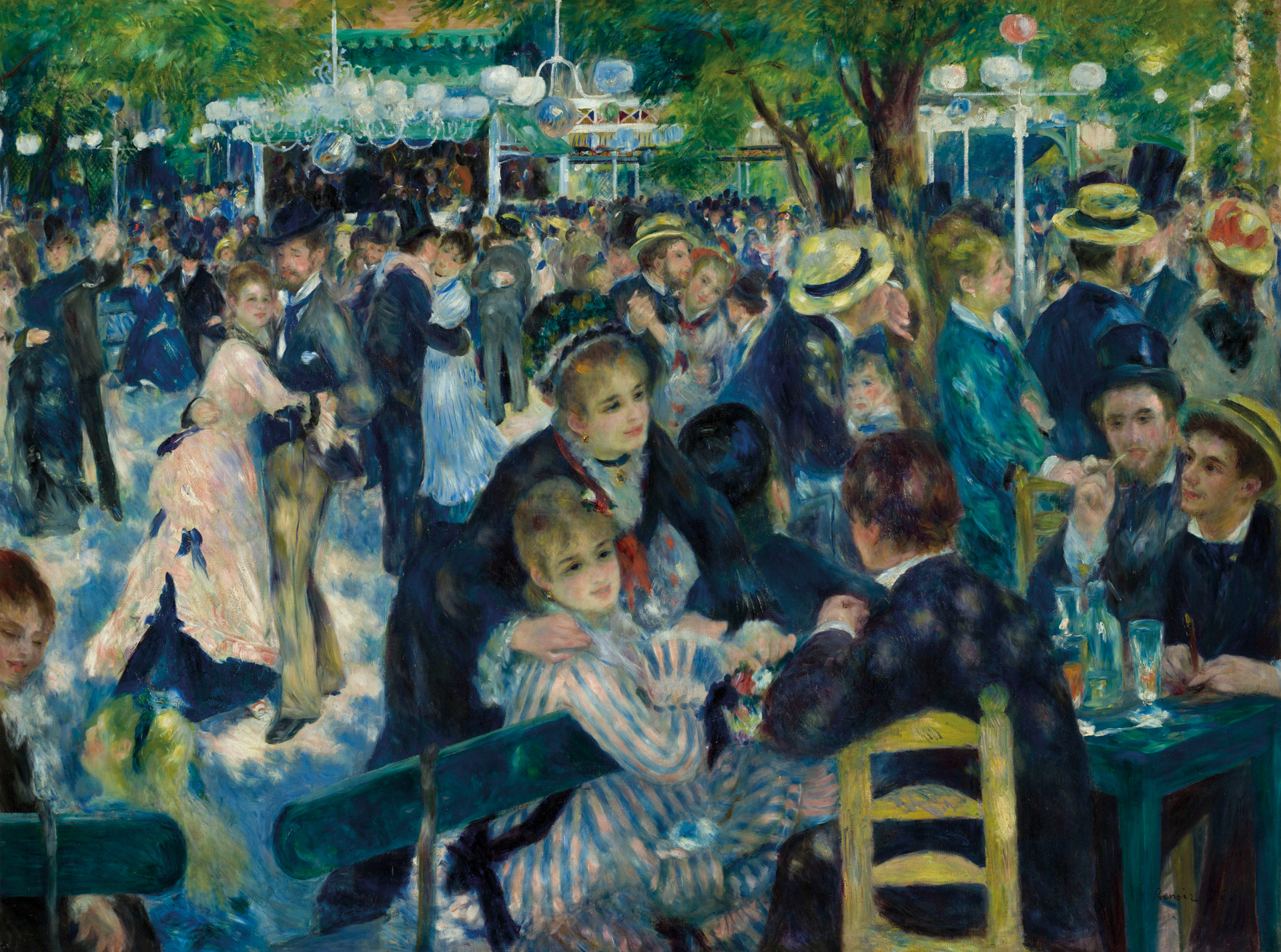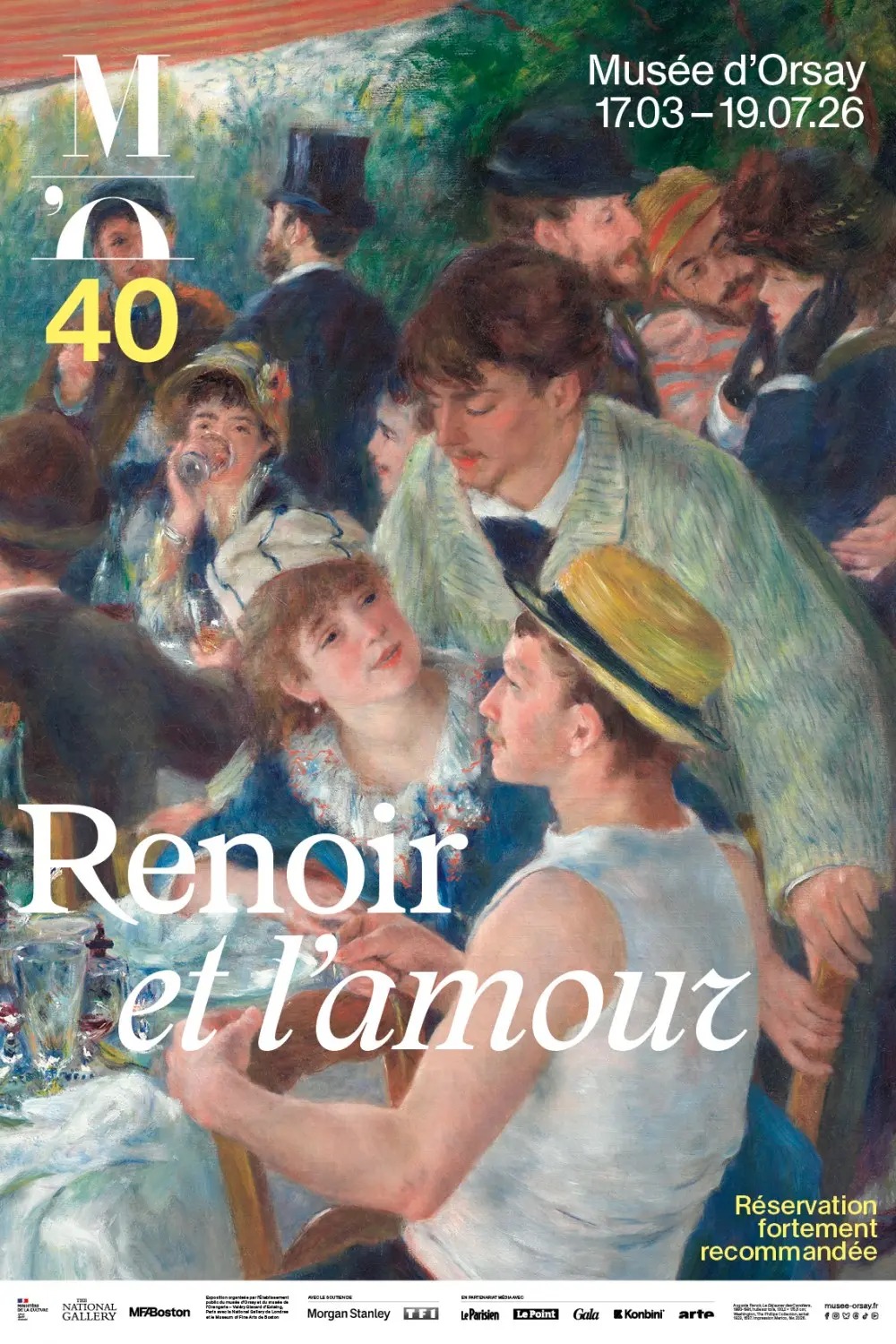
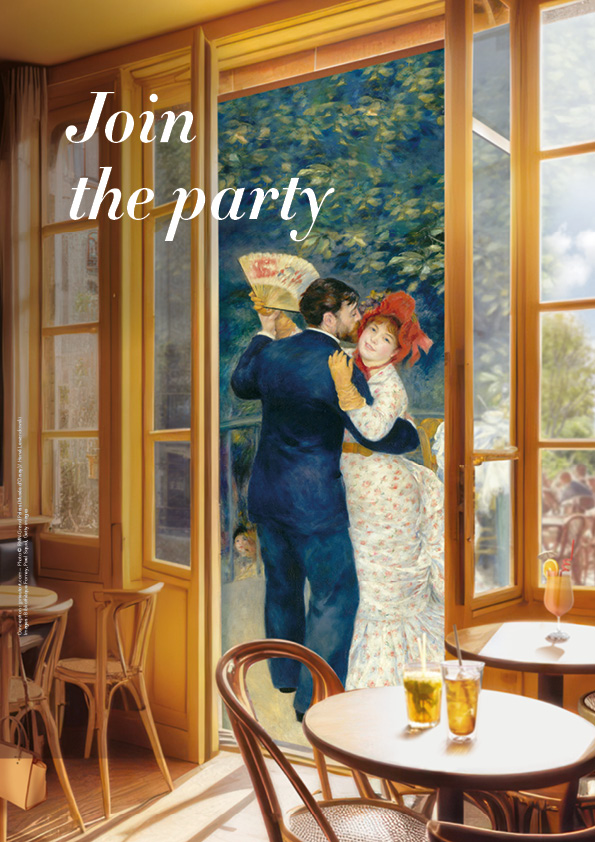
From March 17th to July 19th, 2026, to mark the 150th anniversary of the Dance at the Moulin de la Galette (1876), a masterpiece from its Impressionist collections, the musée d’Orsay presents the exhibition Renoir and love. A Joyful Modernity (1865-1885) .
Auguste Renoir’s joyful, colorful paintings and iconography of guinguettes and public dancehalls led to his being dubbed a “painter of happiness”. A reputation that sometimes led to his being marginalizead among the great painters of modernity, on the grounds that modernity could only be melancholic or ironic, disillusioned or disenchanted.
I know very well how hard it is to make people admit that a painting can be truly great painting while remaining joyful.
Auguste Renoir
Yet his body of work provides an original reflection on modernity, in which love is understood both as a force governing human relationships and as an emotion guiding the artist’s perception of his models, the world and painting itself.
The exhibition Renoir and love brings together this major corpus of “scenes of modern life,” for the first time – multi-figure paintings depicting contemporary subjects (distinct from portraits and landscapes), produced by Renoir during the first twenty years of his career (1865–1885). Among these works, Le Bal du moulin de la Galette (1876) occupies a central place, in connection with the one hundred fiftieth anniversary of its creation. During this period, he took part in the collective invention of a “New Painting” (E. Duranty) alongside Manet, Monet, Morisot, Degas and Caillebotte. He distinguished himself, however, by his unique sense of empathy and capacity for wonder, choosing only happy subjects and always highlighting his models. This “loving” eye is expressed through a pronounced taste for connections – in his motifs (conversations, meals, dances, etc.) as well as in his manner of painting, paying close attention to anything that might contribute to a sense of unity (the characters’ gestures, enveloping light, balanced colors, fluid, rapidly applied brushstrokes that served to merge objects into each other).
This exhibition also highlights Renoir’s predilection for depicting young couples, aiming to debunk the misconception that his painting is “sentimental”. On the contrary, it avoids any overly direct expression of emotions, romantic storytelling or erotic mises en scène. An admirer of 18th – century French painters (Watteau, Boucher and Fragonard), Renoir resurrected an atmosphere of “fêtes galantes” and promoted a form of freedom of morals and gender equality in the Paris of the late Second Empire and early 3rd Republic. This choice should be understood in light of the artist’s biography, as he led a “bohemian life” at the time and maintained relationships deemed “illegitimate” in a 19th century context marked by marriage, bourgeois norms, religious morality, widespread prostitution and major gender inequalities. In this context, Renoir’s large-format paintings devoted to happy couples, to “camaraderie” (as his friend Georges Rivière put it) and conviviality appear as so many manifestos against the violence of gender relations, class antagonisms and the growing loneliness of urban life.
Co-organized with the National Gallery in London and the Museum of Fine Arts in Boston, the exhibition Renoir and love provides a fresh perspective on paintings so well-known that it has become difficult to perceive how truly original they were in their day. For the first time since 1985 – the year the last Renoir retrospective was organized in Paris – an exhibition brings together a limited yet significant selection of works (about fifty paintings) from the first part of the artist’s career, including some of his greatest masterpieces: from La Grenouillère (1869, Stockholm, Nationalmuseum) to Les Parapluies (1881-1885, London, National Gallery), by way of La Promenade (1870, Los Angeles, J. Paul Getty Museum), La Danse à Bouvigal (1883, Boston, Museum of Fine Arts) and Le Déjeuner des canotiers (1880-1881), on exceptional loan from the Phillips Collection in Washington.

Practical informations
17th mar. - 19th jul. 2026
Musée d'Orsay
1 rue de la Légion d’Honneur75007 Paris Tel. : +33 (0)1 40 49 48 14

Practical informations
17th mar. - 19th jul. 2026
Musée d'Orsay
1 rue de la Légion d’Honneur75007 Paris Tel. : +33 (0)1 40 49 48 14