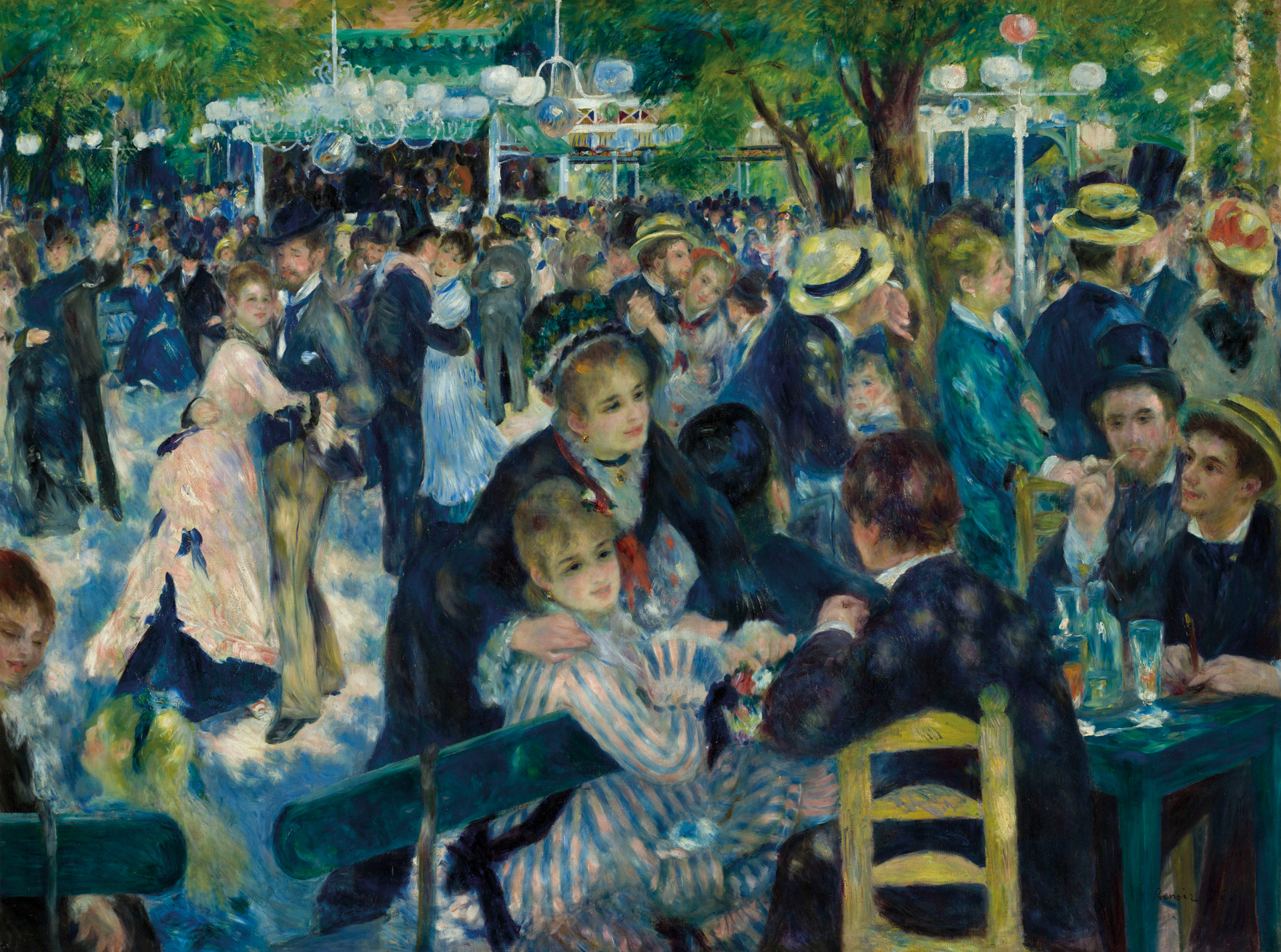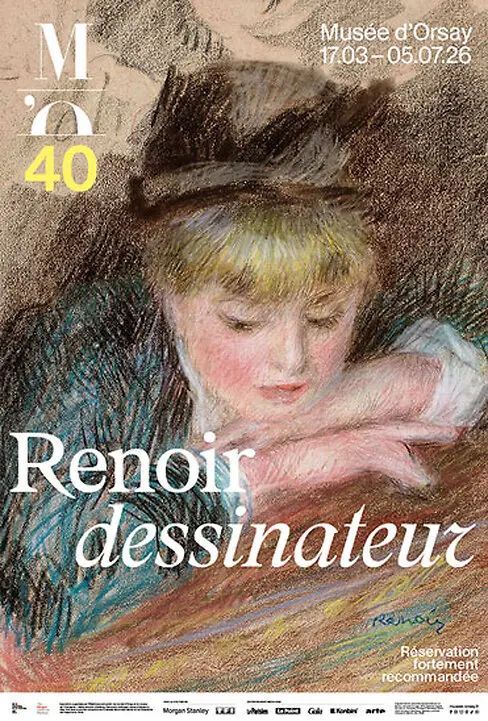
Co-organized with The Morgan Library & Museum, Renoir Dranwings is the first major exhibition devoted to Renoir’s works on paper highlights the importance of graphic techniques in the evolution of his art. Running from March 17th to July 5th, 2026, at the musée d’Orsay, It reveals the close connections between his paintings and drawings, particularly from the 1880s onward, when Renoir moved away from Impressionism while continuing to reinvent his practice.
Although Renoir’s paintings remain icons of Impressionism, his works on paper (drawings, watercolors, pastels, etc.) have not, until now, received the same level of attention. Long regarded primarily as a great painter and colorist, he endured a reputation as a mediocre draughtsman. “A painter who never knew how to draw but who draws well—that is Renoir,” wrote Paul Gauguin in an ambiguous remark.
Yet graphic techniques played a central role in the development of Renoir’s art, from his early student exercises in the 1850s–1860s to his final explorations in the 1910s. Midway through his career, in the 1880s, he placed renewed emphasis on line, inspired by Raphael and Jean-Auguste-Dominique Ingres. Contrary to common belief, Renoir’s drawings are numerous – more than 800 are known today.
For certain works, such as The Bathers. Essay in Decorative Painting and Maternity, Renoir produced numerous studies in his pursuit of the perfect form. Berthe Morisot expressed her admiration for these studies during a visit to Renoir’s studio in 1886:
[Renoir] is a first-rate draftsman; it would be interesting to show the public all of his preparatory studies for a single painting, as they generally imagine that the Impressionists work in a most nonchalant fashion.
The exhibition Renoir Dranwings, featuring over a hundred works from around the world, including sheets rarely shown before, is designed to offer an intimate look into the artist’s creative process, revealing his investigations into light, form, and color.
It also highlights Renoir’s remarkable ease and freedom in approaching a wide range of techniques: graphite drawings, Conté pencil, black stone, charcoal, pen and ink, pastels, watercolors, gouaches, and more. Red chalk occupies a special place in this repertoire, becoming the artist’s preferred medium from the 1880s onward. Renoir was drawn to the flexibility of the line it allowed, its red hue evoking flesh, and its connection to 18th century masters such as Jean-Antoine Watteau, François Boucher, and Jean-Honoré Fragonard, whom he admired.
In the early 20th century, these works aroused the admiration of numerous artists, including Bonnard (“Bonnard speaks with unfeigned modesty […] of Renoir’s drawing, which he believes himself incapable of achieving”, wrote Thadée Natanson) and Picasso, who owned one of Renoir’s most spectacular sanguine drawings (Study for La Coiffure, 1900-1901), presented as a conclusion to the exhibition.

Practical informations
17th mar. - 5th jul. 2026
Musée d'Orsay
1 rue de la Légion d’Honneur75007 Paris Tel. : +33 (0)1 40 49 48 14

Practical informations
17th mar. - 5th jul. 2026
Musée d'Orsay
1 rue de la Légion d’Honneur75007 Paris Tel. : +33 (0)1 40 49 48 14